

By Berit Lolo, Winnie Wangwe & Benard Simiyu

Introduction
Sustainable development is a comprehensive goal that work towards meeting the needs of the present without compromising the ability of future generations to meet their own needs. Sustainability is the foundation for today’s leading global framework for international cooperation, the 2030 Agenda for Sustainable Development and its Sustainable Development Goals (SDGs). It encompasses a balanced approach involving three interconnected pillars: social equity, economic growth, and environmental protection. Together, these pillars aim to create a society where human well-being improves while maintaining the health of the planet. Specifically, social equity ensures fair access to resources and opportunities; economic growth promotes prosperity and quality of life; and environmental protection safeguards natural systems to sustain life and resources long-term.
Sustainable development initiatives achieve greater impact by actively engaging stakeholders, which fosters a sense of ownership, inclusivity, and enhanced effectiveness in meeting development goals. This inclusive approach ensures their diverse perspectives, local knowledge, and varied interests are incorporated into policy and action design, leading to long lasting solutions that are more relevant, culturally sensitive, and widely accepted.
Understanding Stakeholder Engagement in Sustainability
Stakeholder Engagement is an ongoing, mutual process of involvement that goes beyond one-time consultation. It involves creating meaningful spaces and communication channels for dialogue, information sharing, collaboration, and co-creation among all parties affected by or influencing sustainability initiatives. This continuous engagement ensures that diverse perspectives are integrated into decision-making, strengthening the relevance, transparency, and impact of sustainable development efforts.
Common methods and tools used in stakeholder engagement include surveys, interviews, workshops, public consultations, stakeholder forums, advisory boards, and participatory decision-making platforms. These mechanisms facilitate transparent communication, active listening, and collaboration, ensuring stakeholders’ insights effectively shape policies and projects effectively. According to the Global Reporting Initiative, 85% of organizations recognize stakeholder engagement as essential for identifying and managing sustainability risks, making it vital for strategic decision-making, risk mitigation, and delivering impactful sustainability outcomes. Ultimately, stakeholder engagement transforms stakeholders from passive observers into active partners who innovate, provide feedback, advocate, and help implement sustainable practices that build trust, improve reputation, and foster long-term success.
Why Stakeholder Engagement is Crucial for Sustainable Development
Engaging stakeholders in sustainable development offers numerous benefits, including enhanced transparency that builds trust and fosters collaboration. It ensures that diverse perspectives and local knowledge are integrated into the development initiatives, creating shared ownership and responsibility for outcomes. This shared commitment motivates stakeholders not only to support but also actively promote sustainable initiatives. According to the Research Institute of Sweden, highlights that customers, NGOs, and local governments play vital roles in supporting firms’ sustainability transitions by providing information, feedback, and motivation for innovation. Stakeholders serve as innovators by contributing ideas and solutions and serve as reality-checkers validating sustainability efforts, brand advocates promoting sustainable values and provide continuous feedback providers for improvement. Financial contributors among stakeholders enable long-term sustainability initiatives, while community members ensure projects remain relevant and respectful of local contexts.
Challenges in stakeholder Engagement
Challenges in stakeholder engagement in sustainability initiatives encompass a variety of social, cultural, economic, and structural barriers. Social and cultural differences in language, norms, and values can cause misunderstandings and exclusion, while economic disparities limits the capacity of marginalized stakeholders to participate fully. Power imbalances often silence marginalized groups, undermining equity and legitimacy of engagement process. Additionally, many stakeholders face constraints in resources and capacity, which hinder effective and meaningful involvement. Further, there is also the risk of engagement becoming tokenistic, where participation is superficial and fulfills formalities without meaningful influence, causing distrust and weak outcomes.
Strategies for Effective Stakeholder Engagement
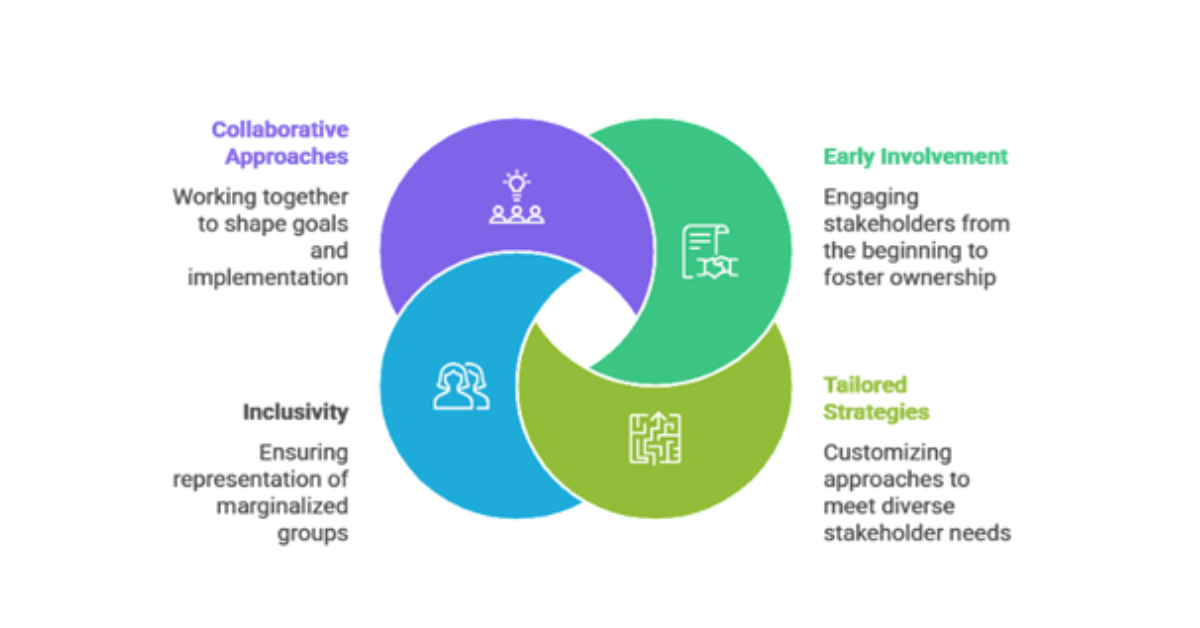
For stakeholder engagement to be effective, the process must be thoughtfully designed from the outset and sustained throughout the initiative. Early involvement during problem identification and planning stages fosters ownership and helps prevent misalignment later phases. Engagement strategies should be customized to address the divers interests, influence, and expectations of different stakeholder groups, with special attention to accommodating marginalized or under-represented populations to ensure inclusivity. Collaborative approaches, where stakeholders actively contribute to shaping not just goals but also implementation mechanisms, yields stronger, more resilient, and sustainable outcomes. Continuous communication, empowerment, and co-creation are key elements that can deepen stakeholder commitment and improve the overall success of sustainability projects.
Impact of Stakeholder Engagement on Sustainable Development Outcomes
Well-executed stakeholder engagement leads to the development of stronger, more context-sensitive policies and projects with broader local support. It enhances resource efficiency, promotes social inclusion, and strengthens environmental stewardship. Engaged stakeholders act as promoters who challenge assumptions and drive innovation aligned with sustainability principles. This support is critical for the achievement of Sustainable Development Goals and helps organizations meet global standards for transparency, fairness, and corporate responsibility. Currently, stakeholder engagement is recognized as a central pillar that makes sustainable development practical, inclusive, and impactful, ensuring that initiatives are both responsive to local needs and aligned with global sustainability frameworks.
The Role of Policy and Governance
Policies play a crucial role in mandating or encouraging stakeholder participation by establishing formal requirements and guidelines for inclusive engagement in sustainable development processes. Such policies often require early, continuous, and meaningful consultation with stakeholders, ensuring transparency, accountability, and respect for diverse perspectives. For example, environmental and social safeguard policies in international funding mechanisms like the Green Climate Fund (GCF) mandate accredited entities to integrate stakeholder engagement in project design and implementation, emphasizing the inclusion of vulnerable and marginalized groups. This legal and procedural framework ensures that stakeholder voices are not only heard but also actively inform and shape development outcomes, reinforcing the legitimacy and effectiveness of sustainable initiatives. Policies like those from UN-Habitat and UNDP further highlight principles such as equality, inclusion, shared responsibility, transparency, and sustainability in stakeholder engagement practices, supporting the achievement of Sustainable Development Goals (SDGs) through multi-stakeholder partnerships and inclusive decision-making.
Governance frameworks promote multi-stakeholder collaboration by establishing structured platforms and mechanisms that facilitate shared responsibility and collective decision-making among diverse actors, including government agencies, private sector, civil society, and communities. These frameworks provide clarity on roles, responsibilities, and processes for cooperation, fostering trust through transparent communication and regular feedback loops. They also support capacity building, conflict resolution, and resource mobilization to sustain engagement over time. Kenya’s SDG stakeholder engagement roadmap exemplifies such frameworks, institutionalizing partnerships and continuous dialogue to enable integrated and scalable progress toward national and local sustainability goals. This roadmap also involves multiple actors including national and county governments, private sector, civil society, academia, youth, parliament, and UN agencies working together through consultative, inclusive, and participatory processes to enhance ownership, legitimacy, and effective implementation of the SDGs.
Conclusion
Stakeholder engagement is fundamental to the successful advancement of sustainable development. When meaningful, early, and continuous engagement is embedded throughout the lifecycle of projects and policies, it fosters a more democratic, adaptive, and impactful approach. This inclusive process cultivates a culture of shared responsibility, transforming sustainability from an isolated goal into a collective journey. For any organization or government committed to sustainable outcomes, investing in strong stakeholder relationships and institutional frameworks is essential to translate vision into reality.